AT THE RISK OF PERMANENTLY DAMAGING MY NERD CRED, I HAVE A CONFESSION.
I suck at video games.
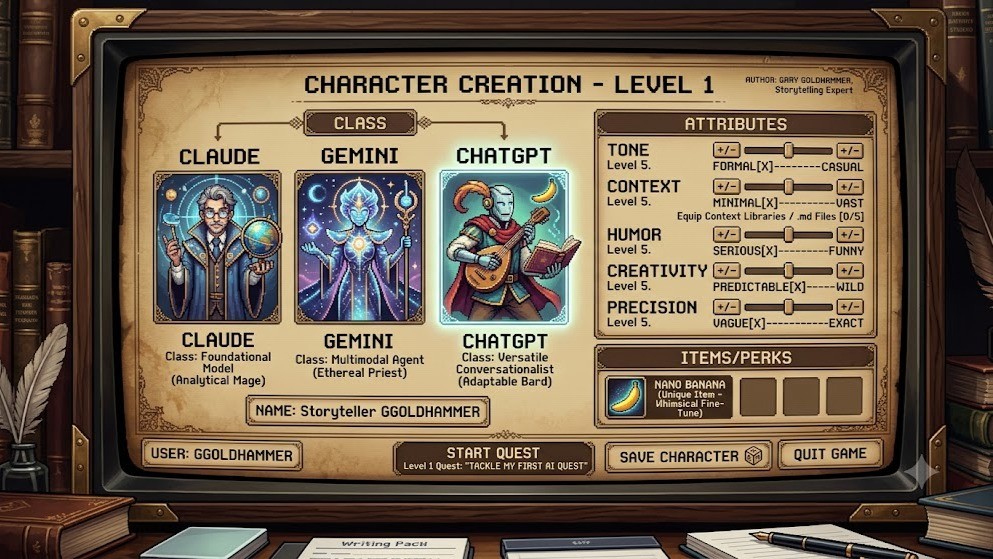
Not the 1980s kind, mind you (I’m not that much of a loser.) Give me Asteroids or Donkey Kong or any version of Pac-Man and I’ll pixel punch you out. But arm me with a first-person shooter or drop me into a Massively Multiplayer Online (MMO) world like Final Fantasy and my brain freezes faster than a Slurpee in liquid nitrogen. I couldn’t even get my head around Dungeons & Dragons, and all you had to do for that was read.
Much of my mental paralysis comes from the seemingly infinite amount of options and customizations involved with modern video games, specifically the role playing variety. Gamers call this “min-maxing,” which is the process of minimizing undesirable character traits and maximizing the positive ones. It’s the dark art of building the most cunning, intelligent, perfect character possible.
We are doing the same thing today with AI. We customize and tweak, uploading instructions or examples and other data meant to make the machine better. To make AI tools sound, write, and act more like us.
We think we are training the model. But we’re not.
We’re creating characters.
We’re playing a game.
Into the labyrinth
In A.G. Riddle’s novel, Labyrinth, a protagonist explains why role-playing games are so addictive:
“We get invested in our character. They start out as basically powerless…and then we pour time and energy into making them more powerful. We level them up.
“There’s a progression that mirrors real life. We all want to develop as we grow older, achieve things we couldn’t before. We’re biologically trained to seek that out. Doing it in a game world is… inspiring in a way.”
The leveling-up we secretly want for ourselves, we instead run as a simulation. One that’s supposed to give us the confidence to tackle our own quests.
When you train a new AI tool, you are rolling a Level 1 character.
It’s a blank slate. A generic, vanilla model that doesn’t know your voice, your preferences, your goals, your visceral revulsion to “in a world” or “at the intersection of” who-the-hell-cares. And as you begin shaping and building the AI’s character, you spend less time on your own.
A flywheel or a flytrap
The min-maxing of AI models is a quest all unto itself. We fine-tune instructions, build context libraries, and create .md files. We cajole and joke and praise, feeding the ever-insatiable beast with more id than ego.
Each adjustment makes the AI a little sharper (we think), which makes us a little more capable (we hope), which makes us feel a little more powerful (we tell ourselves enough to believe.) We then repeat the cycle and continue to optimize. The better the AI gets, the more of ourselves we hand over to the machine so it can get better still.
In Human is the Loop, I argued that every interaction with AI either grows you or shrinks you. There’s no neutral setting. The min-max flywheel feels like progress because, by every metric the AI game offers, it’s getting better. The output is getting better.
But are you getting any better?
A question of character
Train Claude and Claude gets stronger. Train OpenAI or Gemini and they get smarter. Train Copilot and…just kidding.
Do this and your AI of choice, the character you’ve created, will improve over time. Soon it may not even need you to feed it – it will grow all on its own.
Meanwhile, you, the character that actually needs leveling up, are in your own flywheel of diminishing returns. You min-max like crazy to make the machine do what you already can. Sure, in some cases you save time, but more often you spend endless turns instructing and correcting when you could just be doing.
So min-max all you want. But try to spend at least as much time leveling yourself up, too. Build your own character, not anyone else’s.
This is your game to win or lose.
Leave a Reply