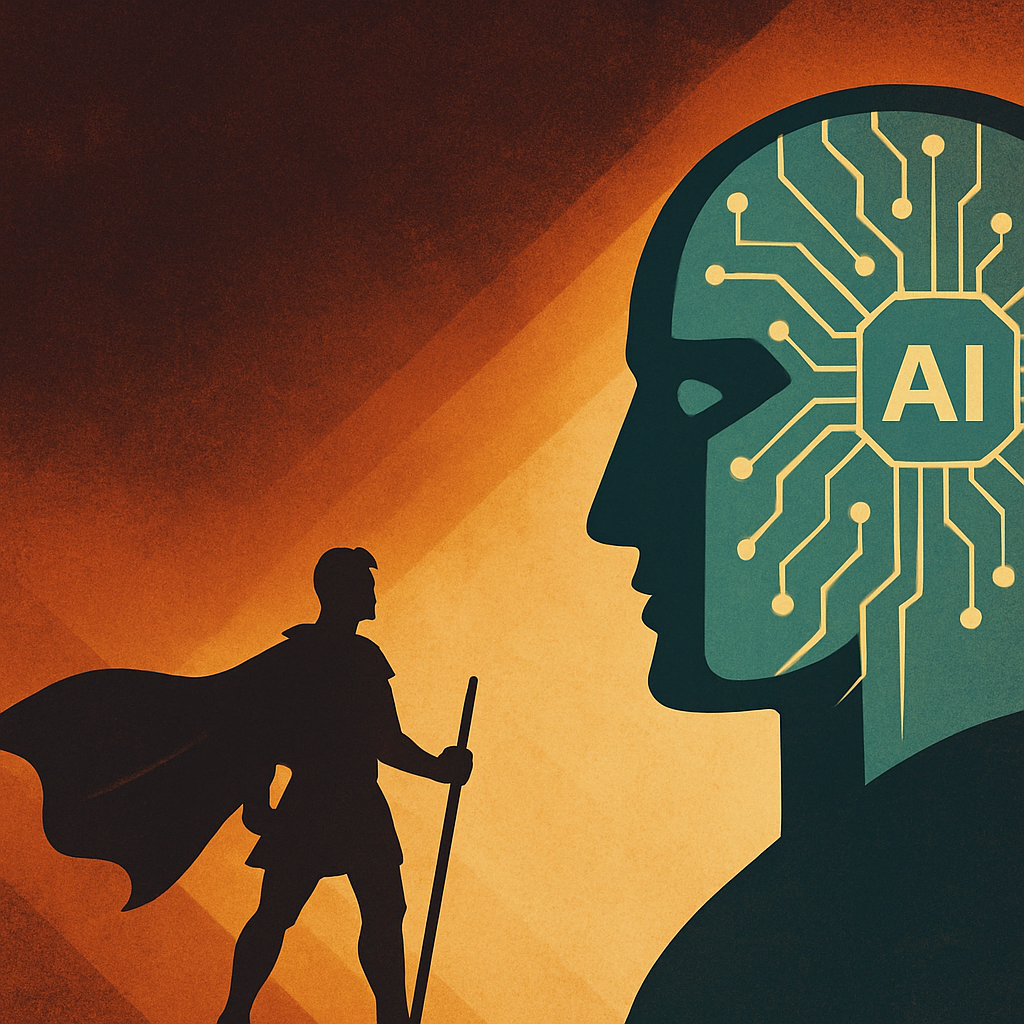
Breaking the Story Code 2.0: The Hero’s Journey in the Age of AI

In 2014, I wrote a blog post called “Breaking the Story Code: The Brand Storytelling Hero’s Journey.” That post was a part of a series, which became a short book, which became presentations and client workshops and applying the methodology with brands like Ford and Bank of America.

I was an anomaly then (and now too) – a digital leader turned storytelling preacher. I was a crusader for authenticity against a backdrop of “content” clogging feeds and funnels with SEO-juiced slop. We turned stories into spreadsheets and then wondered why nobody cared.

I’ve long held a passion for storytelling — I started out as a journalist after all — and frustration with my own profession. In fact, five years earlier in 2009, before becoming WPP’s story guy, I said the following for a book I wrote called The Last Newspaper:

Stories are personal and transformational. Stories have definition and character. Stories are history personified. But content is cold, distant. Content is a commodity – a finite consumable of fleeting value. Content is artificial intelligence.”

Little did I realize how on the nose that would come to be.

A new world of brand storytelling

My original four-step narrative framework – inspired by and adapted from Joseph Campbell’s 12-step Hero’s Journey monomyth – was a simplified guide for brands to break through the content clutter:

  1. Universal Truth: every great story starts from something human and recognizable.
  2. Emotional Hero: someone or something who represents the audience’s struggle.
  3. Twist of Fate: a conflict or unanticipated event that takes the narrative in a new direction.
  4. Transformation: a problem is resolved, the main character or circumstances are changed, and a new “universal truth” is revealed.

That framework still works. But the landscape of storytelling has radically changed.

Today, AI can draft copy, compose music, render faces, mimic voices, and create entire cinematic universes from a text prompt. It can learn and recreate everything from your brand’s tone to your customer’s preferences. Last year the Coca-Cola Company even produced entirely AI-generated TV spots (and despite critical backlash, they did it again this month.)

This is both exhilarating and dangerous. While it’s easier than ever to create stories, it’s getting harder than ever to make them feel human. The AI Coca-Cola holiday ads looked stunning but felt hollow – narratives with the soul of a wax figure.

Let emotion be your guide

AI is incredible at optimizing performance, but emotion isn’t a performance metric. The brands that win will be those that cultivate their emotional intelligence alongside artificial intelligence.

Stories that cut through the noise will carry human stakes: lived detail, vulnerability, specificity. They’ll be attributable, not anonymous; emotionally resonant, not algorithmically optimized.

“We made this with AI” is not a story. That’s not to imply that AI doesn’t matter or that you shouldn’t use it – AI has opened entire new worlds and formats, allowing anyone to create and tell their stories. We’re living in the digital age’s Gutenberg moment; the Internet was mere prologue.

Stories now have superpowers: simulation, multilingual voice, audience-aware branching, spatial presence. AI is a great co-creator and amplifier. The key is to protect the human core and be transparent about the process. If AI helped shape a campaign, then say so and explain how. Transparency is an invitation to trust.

The Hero’s Journey, revisited

I’m still thinking all this through (the downfall of my human design.) And who knows, this post also might turn into a series and an e-book and a workshop. I’m nothing if not predictable.

In the meantime, here’s some actionable advice to consider for your next hero’s journey:

  1. Heart (why it matters): Start with a real stake or tension you can name (an origin, a loss, a risk you took)
  2. Voice (how it sounds): Build a “human voicebook” (cadence, idioms, vocabulary) and train your tools to it
  3. Context (when/where it lands): Time delivery to attention and emotion
  4. Proof (how we trust it): Label AI content and keep “behind‑the‑scenes” reels and sources

Our new “Universal Truth”

AI is a storyteller. So where does that leave us – the writers, strategists, and creatives who trained the AI in the first place?

It leaves us with this truth: Originality is a feature, not a bug.

The more our tools become intelligent, the more we’re reminded that humanity is our ultimate competitive advantage.
Because the most valuable story you can tell will always be your own.

In the Space Between

FERRIS BUELLER WAS RIGHT.

Life moved fast so I did too. I focused on what was ahead of me and missed what was right in front of me.

Because I was building a business while she was learning to read. Because I climbed the corporate ladder and spent most of my time in New York and London and everywhere else but home. 

Because I said I was doing it for her, which was among the first of countless lies.

There were flashes of respectable fatherhood: parades and Fantasmic! at “the Park” (what we in Orange County call Disneyland). Trips to Dave & Busters on Eat & Play Combo nights; midnight “Harry Potter” releases at Barnes & Noble. One time I rebooked a flight from South Korea so I could get back to Newport Beach in time for her volleyball tournament (I made it.)

But sometimes it feels all too little, so too very late.

Because when she had struggles I had meetings. When she was down I was out. And when I was home I often wasn’t present (she once drew a picture of me for an elementary school assignment — sitting on the couch and working on my laptop.)

I had a career. But if all you have is a career, then you have nothing. 

Now she is 26, almost 27, and on Saturday (Oct. 18) she is getting married. She’s been with her fiancé for a while, like two houses and a dog ago, but this will make things official in the eyes of God and the IRS (feel free to use those interchangeably depending on your beliefs.)

Life moves pretty fast, no doubt about it. I learned the hard way that you can always make more money but you can’t make more time.

And now that I’ve slowed the pace, I realized something else: I may not have been around, physically or emotionally, for every milestone throughout my daughter’s childhood. But we had so many fun, sweet, amazing moments — and that’s all this life is. A series of little moments.

Marriages and milestones are great, and we deserve to enjoy them. But most of life is lived in the space between. Those small moments are the ones that really matter.

I only wish I hadn’t taken so damn long to realize it.

So that’s my advice for Alex and her soon-to-be husband Matt: Be in every moment, big or in the space between. Focus on the present, and you’ll never have to worry about the future or be haunted by the past.

Because to exist is a gift. To find love, as my daughter found love, is a blessing.

And for today — and for however many days I have left — I will choose to live in the space between. For her and for me. I no longer have to wait for life to be perfect because it already is.

Because we will never leave her and she will never leave us. Because she will live far away yet never be gone.

But our kids do grow up. 

And they need to move on. 

The Good Fight

THE DECLARATION OF INDEPENDENCE WILL HAVE NEW MEANING THIS JULY 4.

We will celebrate our independence as a nation while we declare our independence from reality. We will attend backyard barbecues as we codify our independence from compassion and rationalize our retreat from common sense. We will light up the sky with fireworks as we extinguish our beacon as leaders of the free world.

We will do it gladly, madly. We will make ourselves blind and claim it’s everyone else who can’t see. We will revise the past, erasing the parts we don’t like – as if history was written in erasable ink and not in sweat, tears, and blood.

We will applaud and cheer. We will buy hats and t-shirts. We will take selfies with the gestapo and spread the government’s propaganda. We will honor traitors with statues and ships, and punish anyone who dares hold those in power accountable.

Get with the program or get out. Keep your mouth shut or rot in a cage.

This may not be you – this isn’t your America, you say. the one you grew up loving despite its flaws (or because of them.) But’s it’s what we are now, it’s what the world will see and think of us, and it’s a history we will have to accept at least in the short term.

Outrage won’t change things. This post won’t change anything either, nor will your memes or rants or repetition of facts or calling out hypocrisy.

Instead, perhaps it’s time for the good to declare their independence from ignorance and fealty. Perhaps the good need to declare independence from parties who only care about preservation, and pledge allegiance to each other and the promise that this 249-year-old experiment still has merit.

Good people created this nation. Good people now need to save it. And if 1776 showed us anything, it’s that anything can happen when the good fight.

Some Things Today are Just Not Okay


Just so I got this straight:

  • Okay: storming the Capitol to stop the legal election of a U.S. President, threatening to kill elected leaders and killing a police officer
  • Not okay: protesting discrimination against legal immigrants with no violence (other than a few idiots burning driverless cars) and no destruction of government property 
  • Okay: separating parents from children who have legal rights to be in the US 
  • Not okay: Raising families and contributing to the culture and economy 
  • Okay: Confederate flags 
  • Not okay: Mexican flags, Venezuelan flags, pretty much any other non-US flag
  • Okay: Suppression  
  • Not okay: Expression
  • Okay: Spreading lies 
  • Not okay: Your own eyes  
  • Okay: Red states’ rights 
  • Not okay: Blue states’ rights 
  • Okay: Conspiracy theories 
  • Not okay: Facts 
  • Okay: Bans
  • Not okay: Trans
  • Okay: Revisionism
  • Not Okay: Education
  • Okay: Military parades 
  • Not okay: Pride parades
  • Okay: Increasing deficits  
  • Not okay: Medicaid benefits 
  • Okay: Ignoring the law and courts
  • Not okay: Upholding the Constitution  
  • Okay: America
  • Not okay: Americans

Living an Unfinished Life

“IT’S FUN GETTING OLD.”

He was joking, in that adorable old man manner of sarcastic whimsy — the kind that elicits a polite laugh the first and fifteenth time you hear it. I chuckled and nodded, and then we both continued our respective ritual morning walks in opposite directions.

I didn’t mind the comment. After all, he was referring to my recently replaced shoulder and my slow but sure road to recovery. Young people usually don’t walk around with titanium implants, so I get it. I shouldn’t be upset with him, I should be upset with the years of white collar wear and tear, the constant travel and the poor posture that led to a premature erosion of my bones. I’d also like to blame playing a heavy electric guitar in a band since middle school but that’s way too cool of an excuse for someone like me.

What really bothered me was the suggestion — as innocuous or unintentional as it may have been — that “old” means the “end.” That at some point you wake up and say “well, that’s it, I’m done.”

But that’s a choice. Aging is inevitable, but “old” is a decision.

You can retire from work, but retire from life? That’s a waste.

I’ll be done when I’m dead. But in the meantime, life is meant to be unfinished. It’s an open-ended question that will never be answered. There’s always more to experience and learn.

The trick is to go do it. You can always make more money but you can’t make more time, so go — take the trip, eat the weird food, learn that new skill. Most of all never, ever consider yourself a finished product.

You know what? I take it all back.

It’s fun getting old.

“We’re Landing in 20 Minutes”

THERE’S A TIME AND A PLACE.

The time was 8:47 pm. The place was the Potomac, on approach to Reagan National Airport in Washington, D.C. A U.S. Army helicopter collided with an American Eagle flight, killing all 64 passengers and three military personnel.

The river was on fire as politicians and pundits cried havoc. Bodies lay crushed as social media exploded with theories and absolutes – there weren’t enough air traffic controllers, it was the helicopter’s fault, it was Biden’s fault, it was Diversity, Equity and Inclusion’s fault.

Worst of all, the Coward in Chief of the United States said it was anyone’s and everyone else’s fault, not because he was to blame either, but because he was scared of looking vulnerable or having to be accountable. He even signed an executive order blaming Joe Biden and DEI for the tragedy. That’s something a fucking child does when he gets caught stealing from the cookie jar and wants to get ahead of the facts by pinning it on his sister. Pathetic.

Politics and the blame game have always waded into the flotsam of disasters. We saw that play out in Southern California as parts of Los Angeles burned. But there used to be a “timeout” to mourn, a brief period to focus on loss of life first, then the politics. There was space for empathy – real thoughts and actual prayers.

In D.C. there was virtually no pause to reflect on the names and faces who shared a collective final breath. People were dead, blown apart in a fireball over the nation’s capital, and it was as if they were just more collateral damage in our festering political war.

This is where we are now. A nation once defined by community and compassion now fractured by pandemic isolation, digital echo chambers, and the relentless tribalism of identity politics.

Empathy is a fragile thing. It can’t survive if we stay hidden behind screens and separated by algorithms. Empathy requires being with people, talking to them and understanding them. We don’t need to agree with people to have empathy – agreement has nothing to do with the other person at all. Empathy is caring about someone else because you share a human connection, not an ideological one.

But outrage is easier than understanding. Every crisis is now an excuse to reaffirm our own righteousness.

Blame is easy. It’s the dominion of cowards and fools. It’s for people with no grasp on their own mortality.

But trust me, as someone who has seen mortality’s face up close more than once, there’s no universal measure of a lifetime.

Could be 100 years, 80 or 48. You could have a decade more, five years or a few months.

Or you could be on approach to Reagan National Airport, sending a routine text to your husband who has dinner waiting for you on the kitchen table.

“We’re landing in 20 minutes.”

Politics is inevitable. But there’s a time and a place.

Goodbye SEO, Hello AEO — Agentic Engine Optimization

The better part of my career was spent on SEO – working to get clients “above the fold” on Google by gaming a system that kept changing the rules. Keywords were the gold nuggets of content marketing; “storytelling” became a euphemism for flooding the zone with mindless copy.

SEO today isn’t dead, but it’s dying. Fast.

People don’t want links; they want answers and ideas. They don’t want clicks, they want context.  Most of all they don’t want to search – they want to find. Even better if someone, or some technology, could find for them.

In discussing this with my PwC colleague and EmTech leader Larry Gioia, we realized that in a world of AI agents and platforms like OpenAI’s Operator, where agents are using web properties and services to fulfill a task, the rules of search have forever changed.

If you’re still optimizing your content for search – stuffing headlines and first paragraphs with keywords, backlinking and all the rest – then you’re doing it wrong. You need to optimize your content for agents.

Goodbye, SEO, hello AEO – Agentic Engine Optimization.

The fold is gone, replaced with a “results page for one” catered to your exact needs (the ad model can’t be far behind.) You don’t have to search when search is done for you in the blink of an AI.

With AEO you get answers as well as actions. We’ve known for a long while that LLMs were able to understand the meaning behind user queries and generate relevant content without relying on specific keywords – but now the technology and tools have caught up and created an entirely new modality for how we engage, seek information and solve problems.

SEO gave people work to do; AEO does work for people.

With AEO, content is structured around topics rather than just keyword density. Content needs to be authoritative and conversational so that AI can extract and summarize effectively. Engagement-friendly formats such as FAQs, summaries, and interactive/multimodal elements are now more crucial for optimization.

This is good news for real content creators and bad news for content marketing bottom feeders still panning for digital gold. AEO is both a paradigm shift and a paradox – an AI-driven strategy that works best when fed with authenticity and natural language.

SEO was search optimized for machines. AEO is search optimized for humans. In many ways, AEO is more real and human than SEO ever was.

Newspapers at the Tipping Point

THIS ISN’T POLITICAL.

I don’t talk about politics online. If you know me then you already know where I stand — and if you don’t know me, then you really shouldn’t give a shit what I think. Hell, I barely give a shit what I think.

But like I said, this isn’t political, so I hope you’ll indulge me.

Over the past few days, both the Washington Post and my hometown Los Angeles Times announced they would not endorse any candidate for US President. Correction: the billionaire owners of the Washington Post and the Los Angeles Times announced that their publications would not endorse any candidate for US President.

That’s their right, of course. They can do whatever they want.

A newspaper endorsement usually represents the owner’s point of view. Owners can also choose not to endorse at all. I understand why members of both the Post and Times were upset by this decision, and why others resigned in protest — a newspaper should (used to) rise to the highest standards of ethics and integrity. By that criteria alone, the choice in this election is obvious.

But again, I’m not going to be political. There are plenty of places to go for that stuff.

I’m not going to be political, but what the Post and Times owners did absolutely was. And by deciding not to say anything, they spoke volumes.

This wasn’t a moral or ethical choice. This wasn’t about being impartial or unbiased. Both papers still endorse other national and local candidates and will continue to do so.

No, this was about two men who, less than two weeks before a coin-flip election, decided to hedge their bets and not piss off a potential President who has promised revenge against anyone who goes against him.

Jeff Bezos, who owns the Washington Post, and Dr. Patrick Soon-Shiong, who owns the Los Angeles Times, made a business decision, not a values-based one. They don’t care about journalism— I personally believe they never did — they just care about not falling into disfavor with a certain administration. A Chamberlain-esque move that sets a dangerous precedent.

Endorsements from either paper weren’t going to change the outcome of the election. They weren’t going to change people’s minds. But to paraphrase a line from the musical Hamilton, if you stand for nothing then what will you fall for?

I was a newspaper journalist and proud of it. I’m not sure I’d be proud today. I could accept newspapers closing, pages thinning, circulations dropping. I wasn’t happy about it but I could accept it. Economies change and businesses need to adapt.

But I can’t accept cowardice. I can’t accept appeasement of principle. I can’t accept silence when every voice needs to be heard.

This isn’t political, it’s personal. This isn’t about politics, it’s about the Body Politic.

In 2010, I published a book called “The Last Newspaper,” an analysis of both the industry’s decline and the bright spots that would grow in the decades to come as information atoms gave way to bits. I ended the book with the promise that “Where there is journalism, there is hope.” I shared the idea, immortalized in 1908 by Walter Williams, first dean of my alma mater, the Missouri School of Journalism, that “the public journal is a public trust; that all connected with it are, to the full measure of their responsibility, trustees for the public; and that acceptance of a lesser service is a betrayal of this trust.”

Bezos and Soon-Shiong betrayed that trust. And in doing so, betrayed all of us.

Finding your Fixed Point

The best advice I ever got was on the golf course. Even by the most liberal standards my game was terrible – I had all the sports acumen of an awkward Jewish kid from the Valley whose mom made him play catcher because at least he’d have to wear a mask. Still broke my glasses twice (always the overachiever.)

Bad posture and lack of any core strength aside, my swing was all over the place. My instructor smothered me with demonstrations and tips and videos and cheat codes to trick the ball into doing what golf balls are designed to do.

It worked some of the time. It didn’t work most of the time. A maddeningly perfect metaphor for life – I kept trying no matter how bad I was at it.

And then I learned about the fixed point.

A close friend and genuinely good golfer saw what I was doing, could see my brain calculating All The Things – feet position, club face, backswing, hip movement, follow-through – and failing miserably. It was like trying to hit a golf ball using a Rube Goldberg machine.

Slow it down, he said. Forget about all the steps. Just look at the ball and find a spot – any spot – and aim your club. That spot is your fixed point. Don’t do anything else except focus on your fixed point.

So I did. And the ball flew, high and straight. I tried it again, same result. I focused on my fixed point and nailed that obnoxious Titleist down the fairway like kicking a bad habit.

Golf is still frustrating – that’s just what golf is. There are no perfect days. There’s joy and pain. Sometimes you question why you keep playing when you know how it’s going to end.

Focus often feels like a luxury. We multitask and juggle schedules and make personal and professional promises we can’t possibly fulfill without ending up in therapy or a mortuary. We mistake activity for progress. “Time to think” doesn’t look good on a billable hour report.

But to do it all is to do nothing at all.

Find your fixed point and focus. Block out the noise and the distractions. Tell your doubts to take a day off.

Then swing like hell.

We are Always Just Beginning

ABSENCE AND PRESENCE.

We see them as being different. Absence cannot be presence, so therefore presence cannot be absence. It’s immutable fact.

Not exactly.

You can be there and also not there. Present while absent. I know this to be true because I’ve seen it. In fact I saw it recently, on a sun-drenched hill overlooking a serene Ozark lake.

My wife’s aunt Scottie died so long ago I can’t remember. But I also can’t forget her, no more than I can forget the color of the sky.

Her story continued over the years, told and retold as if scripture. People who never met Scottie would swear they knew Scottie, could hear her infectious laugh and see her gleaming smile. She was so much bigger than life that life could no longer contain her.

So when I saw that smile attached to her granddaughter’s bridal bouquet, it made all the sense in the world.

Scottie, like the bride’s maternal grandfather whose gentle face also adorned that special bouquet, was a beloved link in the family circle. But circles don’t break when someone dies, they expand. Her presence just grew bigger, that’s all. Her embrace widened to hold a fresh set of family members now joined by marriage, her stories soon to become their stories too.

Circles expand.

They encompass new lives and create new experiences. They remind us that no matter how far we’ve come, we are never at the end.

We are always just beginning.